September 2026 Jobs Report: The Latest Employment Trends

September brought another month of limited hiring, reinforcing a labor market that remains stable but increasingly cautious.
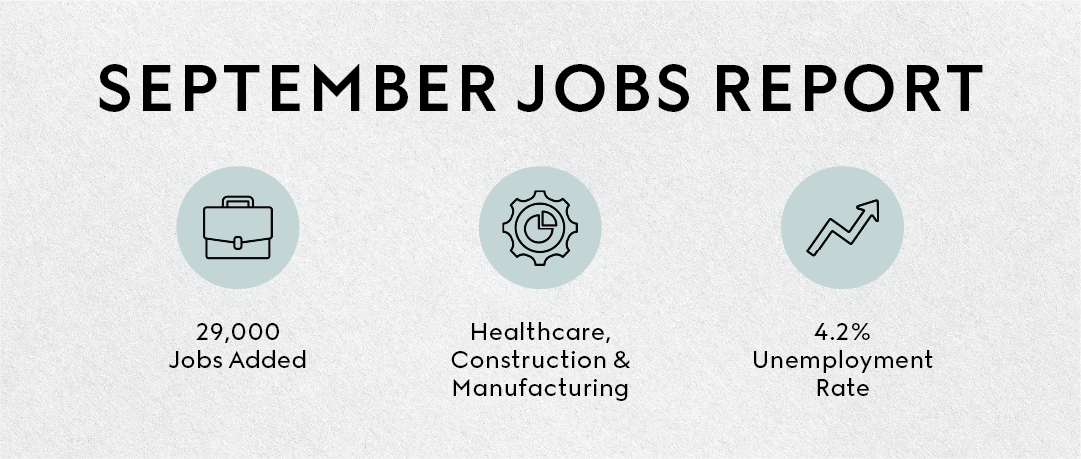
The U.S. economy added 29,000 jobs in September, below the average monthly gain of 45,000 over the prior year. The unemployment rate remained relatively steady at 4.2%, continuing the narrow range it has maintained since March.
Perhaps more telling than the headline number is how little movement occurred across the economy. Employment changed little in every major industry, suggesting employers are largely maintaining their current workforces rather than significantly expanding or reducing them.
Hiring Activity Was Limited Across Industries
Unlike recent months, September did not have one or two sectors driving significant employment growth.
Healthcare continued to add jobs (+17,000), but at a slower pace than its average over the past year. Ambulatory healthcare services and hospitals continued to grow, while nursing and residential care facilities lost jobs.
Modest gains occurred in construction (+11,000) and manufacturing (+9,000). Manufacturing has gradually strengthened throughout 2026, adding 72,000 jobs since its recent low in December 2025.
Meanwhile, financial activities continued to face longer-term pressure. Although employment changed little in September itself, the industry has lost 129,000 jobs since its recent peak in May 2025, with much of that decline occurring in insurance.
Across retail, information, professional and business services, transportation, leisure and hospitality, government, and several other major industries, employment was essentially unchanged.
Rather than signaling widespread job losses, September reflects a labor market where employers appear hesitant to make major workforce changes in either direction.
Stability Remains, But Hiring Momentum Is Limited
Despite slower job creation, the broader labor market remains relatively stable.
The unemployment rate has stayed between 4.1% and 4.3% since March, while labor force participation and the employment-population ratio showed little change in September. Long-term unemployment also remained relatively steady.
Wage growth continued, but at a more moderate pace. Average hourly earnings increased 3.0% over the past year, suggesting some of the wage pressure employers experienced during tighter labor markets continues to ease.
Revisions to previous months also softened the recent hiring picture. July was revised from a gain of 21,000 jobs to a loss of 10,000 jobs, while August's gain was revised from 162,000 jobs to 133,000 jobs. Combined, July and August employment growth was 60,000 jobs lower than previously reported.
Taken together, September's data points to a labor market that is not deteriorating sharply, but has clearly lost momentum. Employers are holding onto workers, unemployment remains relatively low, and hiring continues, but expansion has become much more selective.
What This Means For Employers
For employers, September's report suggests there may be more room to approach hiring strategically.
With fewer organizations expanding aggressively, competition for talent may be less intense than it was during stronger hiring periods. At the same time, specialized and high-demand talent can still be difficult to secure, particularly in areas where hiring remains consistent.
This environment gives employers an opportunity to:
- Focus hiring resources on roles with the greatest business impact
- Reach experienced candidates who may be exploring opportunities in slower-moving industries
- Reevaluate job requirements to ensure they reflect the skills actually needed for the role
- Maintain an efficient hiring process even when candidate availability improves
A slower market does not necessarily mean employers should slow their hiring processes. Strong candidates remain valuable, and organizations that know exactly what they need can use a more measured market to make thoughtful, high-impact hires.
Are you looking for top talent? Reach out to us today to get started.
What This Means For Job Seekers
For candidates, September's report reinforces the importance of being deliberate in a slower hiring environment.
Employers are not broadly cutting jobs, but they are also not creating positions at the pace seen in stronger labor markets. That can mean fewer openings, more competition for individual roles, and potentially longer hiring timelines.
Candidates can strengthen their position by:
- Targeting opportunities where their experience closely matches business needs
- Clearly demonstrating results rather than simply listing responsibilities
- Looking beyond their current industry for roles where their skills can transfer
- Staying consistent and patient as hiring decisions become more deliberate
Healthcare continues to provide relatively consistent opportunities, while the gradual improvement in manufacturing may also create openings. Candidates coming from industries experiencing longer-term contraction, such as financial activities, may benefit from identifying how their experience translates to sectors with more stable demand.
September's report is ultimately a reminder that a quiet labor market is not an inactive one. Employers are still hiring, and candidates are still moving, but both sides are becoming more intentional about the decisions they make.
Looking for your next career change? Explore our open jobs today.
For further reading, refer to the U.S. Bureau of Labor Statistics or check out our other blogs on topics related to the job market.
Get the latest updates and exclusive content – subscribe to our newsletter!
Partner with Premier today.
Where in striving to do better, we transform lives in shared partnership with our exceptional employer and talent communities.