
October's jobs report offers an encouraging sign that hiring activity is picking up after several months of uneven growth.
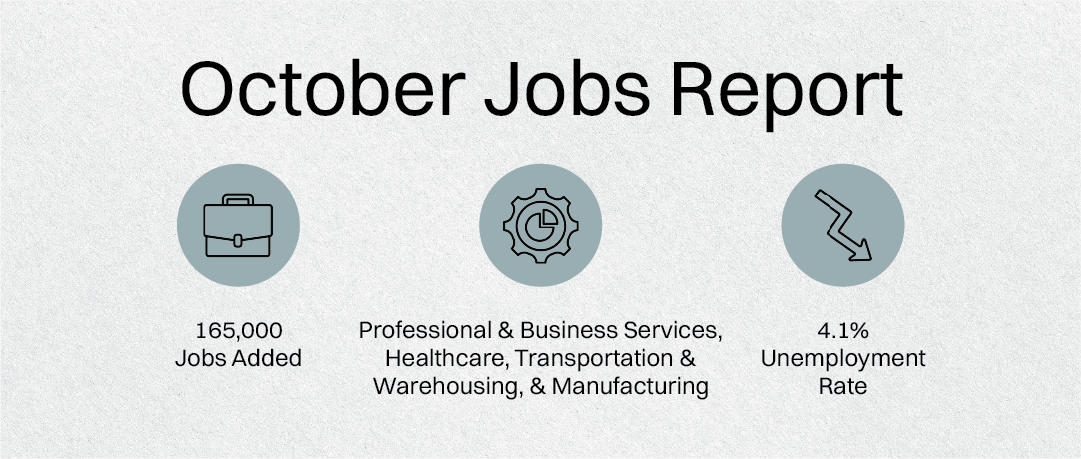
The U.S. economy added 165,000 jobs in October, significantly above the average monthly gain of 48,000 jobs over the past year. Meanwhile, the unemployment rate remained relatively steady at 4.1%, continuing the narrow range it has maintained since March.
The most encouraging is where the growth occurred. Professional and business services led hiring, while healthcare, transportation, and manufacturing also posted gains. Upward revisions to August and September combined is 84,000 jobs higher than previously reported totals, suggesting hiring momentum heading into the fall was stronger than initially estimated.
Hiring Gains Extend Across Key Industries
October's strongest gains came from industries that support business operations, essential services, and economic activity.
Professional and business services led the way, adding 70,000 jobs, well above its average monthly gain over the past year. Growth across professional and technical services, administrative support, and business management suggests employers are increasing investment in the expertise and operational support needed to sustain their businesses.
Healthcare also posted a stronger month, adding 42,000 jobs. Hospitals, home health care services, and outpatient care centers continued to expand, reinforcing the industry's role as a consistent source of employment growth.
Meanwhile, transportation and warehousing added 25,000 jobs, driven largely by courier and delivery services. The industry has steadily recovered from its employment low earlier this year, reflecting renewed demand in certain logistics operations.
Manufacturing continued its gradual recovery, with gains in computer and electronic products, machinery, and primary metals. Employment in the industry has increased by 101,000 jobs since December 2025, pointing to sustained improvement after a period of slower activity.
Although most other major industries showed little change, October's gains suggest hiring momentum is extending beyond the service-oriented sectors that drove much of the growth earlier in the year.
A Stronger Hiring Picture, With Some Pressure Beneath The Surface
Beyond the headline employment gains, several indicators point to continued labor market stability.
The unemployment rate remained at 4.1%, while labor force participation and the employment-population ratio showed little movement. Wage growth also continued, with average hourly earnings increasing 3.1% over the past year.
Revisions to previous reports strengthened the overall picture. August's job gains were revised upward to 186,000 jobs, while September's gains increased to 60,000 jobs. Together, these adjustments suggest that hiring activity was stronger than initially reported.
However, not every indicator points to improvement.
The number of people working part-time for economic reasons increased by 339,000, suggesting more workers are experiencing reduced hours or difficulty finding full-time employment. Long-term unemployment also remains elevated, with approximately 2 million people unemployed for 27 weeks or longer.
Taken together, October's report points to a labor market that is regaining momentum, though the recovery remains uneven. Employers are creating more jobs, but some workers continue to face challenges securing stable, full-time opportunities.
What This Means For Employers
For employers, October's report suggests hiring competition could begin to increase in certain industries as businesses regain confidence in expanding their teams.
The strength in professional and business services is particularly notable, indicating renewed demand for specialized expertise, operational support, and business-critical talent. At the same time, continued growth in healthcare, transportation, and manufacturing reinforces the importance of understanding how hiring conditions differ across industries.
This environment presents an opportunity for employers to:
- Reassess hiring priorities as business needs evolve heading into 2027
- Move proactively on critical positions before competition for qualified talent increases
- Strengthen workforce planning to balance immediate hiring needs with longer-term business goals
- Evaluate where flexible staffing solutions can support growth without overextending resources
While hiring activity is improving, employers should avoid assuming that talent availability is the same across every function or industry.
Organizations that approach hiring with clear priorities, realistic expectations, and efficient decision-making processes will be better positioned to secure the talent they need.
Are you looking for top talent? Reach out to us today to get started.
What This Means For Job Seekers
For job seekers, October's report offers a more encouraging outlook as hiring activity picks up across several industries.
Growth in professional and business services is particularly promising for candidates with experience in business operations, administration, technical services, and other professional functions. Healthcare, transportation, and manufacturing also continue to create opportunities.
However, the increase in workers employed part-time for economic reasons and the continued level of long-term unemployment suggest that competition remains a factor, particularly for candidates seeking stable, full-time positions.
Candidates can strengthen their position by:
- Targeting industries and employers demonstrating consistent hiring demand
- Highlighting specialized expertise and measurable business impact
- Exploring opportunities where transferable skills can support different functions or industries
- Preparing for hiring processes that may remain selective despite improving job growth
As organizations begin planning their workforce needs for 2027, candidates who can clearly demonstrate how their experience supports business priorities may be especially well positioned.
October's report is a reminder that hiring momentum can return without every part of the labor market improving at the same pace. For both employers and candidates, understanding where opportunities are emerging remains essential.
Looking for your next career change? Explore our open jobs today.
For further reading, refer to the U.S. Bureau of Labor Statistics or check out our other blogs on topics related to the job market.