

May 2026 Jobs Report: The Latest Employment Trends

May’s jobs report suggests the labor market remains remarkably stable, even as hiring becomes increasingly concentrated in a handful of industries.
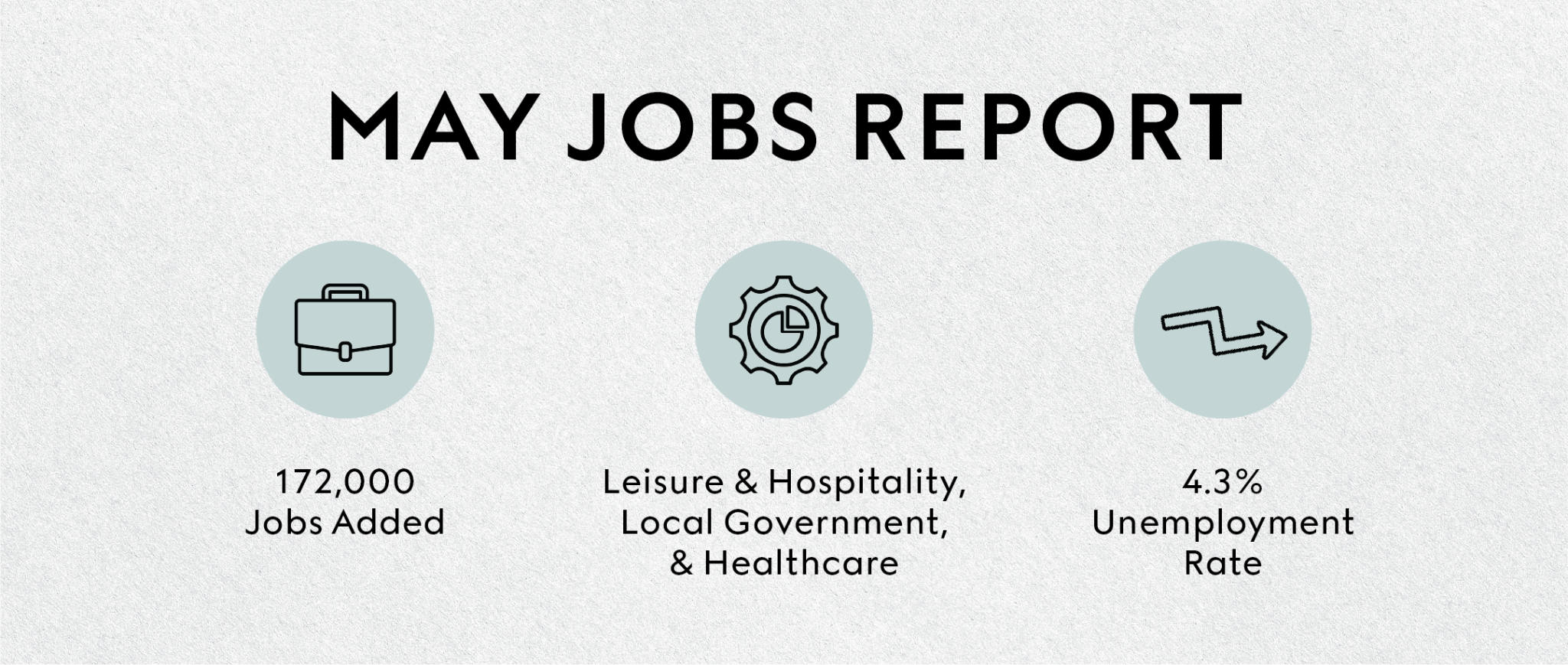
The U.S. economy added 172,000 jobs in May, continuing a trend of moderate growth seen over the past several months. The unemployment rate remained unchanged at 4.3%, where it has largely hovered since mid-2025. At the same time, revisions to March and April added a combined 93,000 jobs, indicating the labor market may have been stronger this spring than initially reported.
The bigger story this month is not whether jobs are being added, it’s where they’re being added. Hiring remains healthy in service-oriented sectors, while other industries continue to face headwinds. This uneven pattern highlights a labor market that is growing, but selectively.
Growth Remains Concentrated In Service-Based Industries
May’s strongest gains came from industries tied to consumer spending, healthcare, and local government.
- Leisure and hospitality led the way, adding 70,000 jobs, far above its average pace over the past year. Much of this growth occurred in restaurants and food service establishments, signaling continued consumer demand despite broader economic uncertainty.
- Local government also posted a surprisingly strong month, adding 55,000 jobs, primarily outside of education-related roles.
- Healthcare continued its steady expansion, adding 35,000 jobs, with hiring concentrated in ambulatory care, home health services, and hospitals.
- Social assistance remained another consistent source of growth, adding 12,000 jobs, continuing a trend that has persisted throughout much of the past year.
However, not all industries are moving in the same direction.
- Financial activities continued to decline by 22,000 jobs, extending a year-long contraction in banking and insurance-related employment.
- Transportation and warehousing remained essentially flat, despite modest gains in some subsectors.
- Most other industries, including manufacturing, construction, professional services, and retail, showed little meaningful movement.
The result is a labor market where growth remains concentrated in sectors tied to care, government services, and consumer activity rather than broad economic expansion.
The Labor Market Remains Stable, But Signs Of Softness Persist
The headline numbers suggest stability, and many key indicators support that view.
The unemployment rate remained unchanged, labor force participation held steady, and the total number of unemployed workers saw little movement. Wage growth also continued at a healthy pace, with earnings rising faster than inflation.
At the same time, there are a few trends worth monitoring.
Long-term unemployment continues to rise compared with a year ago, suggesting some workers are taking longer to reconnect with opportunities. Additionally, the share of unemployed individuals who have been out of work for more than six months remains elevated.
Taken together, the data suggest the labor market is neither overheating nor weakening significantly. Instead, it appears to be settling into a slower, more sustainable pace of growth.
What This Means For Employers
For employers, May's report reinforces that talent markets continue to vary significantly by industry.
Organizations in healthcare, hospitality, social services, and public-sector-adjacent industries may still face hiring competition, while employers in finance, technology, and other slower-growth sectors may find greater access to experienced candidates.
This environment presents an opportunity to:
- Recruit talent from industries undergoing restructuring or slower growth
- Focus on retention strategies as wage growth remains steady
- Make strategic hires without facing the extreme labor shortages seen in recent years
The strongest hiring outcomes will likely come from employers who balance speed with selectivity and maintain a compelling employee value proposition.
Are you looking for top talent? Reach out to us today to get started.
What This Means for Job Seekers
For job seekers, May's report highlights the importance of understanding where demand is strongest.
Opportunities continue to be concentrated in healthcare, hospitality, government services, and social assistance, while hiring remains more cautious in financial services and several white-collar industries.
Candidates may benefit from:
- Expanding their search to industries with sustained hiring momentum
- Emphasizing transferable skills and adaptability
- Remaining flexible about role type, industry, or career path
While the labor market remains competitive, employers are still hiring. The key difference is that growth is increasingly concentrated in sectors with long-term demand rather than spread broadly across the economy.
Looking for your next career change? Explore our open jobs today.
For further reading, refer to the U.S. Bureau of Labor Statistics or check out our other blogs on topics related to the job market.
Get the latest updates and exclusive content – subscribe to our newsletter!
Partner with Premier today.
Where in striving to do better, we transform lives in shared partnership with our exceptional employer and talent communities.


