

January 2026 Jobs Report: The Latest Employment Trends

The latest job report for January provides a comprehensive snapshot of the current state of employment in the United States, along with revised data from 2025 due to the annual benchmarking process.
January’s Key Findings
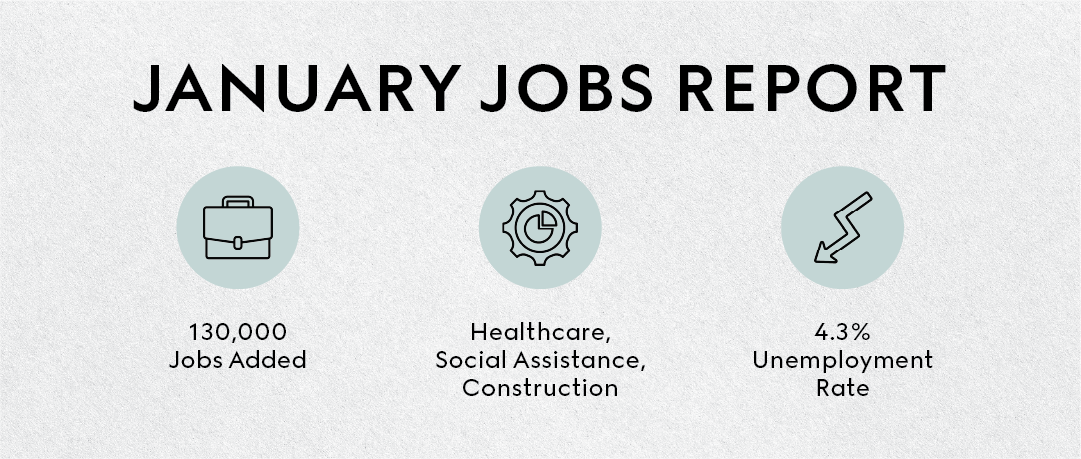
The U.S. Bureau of Labor Statistics reported that nonfarm payroll employment increased by 130,000 jobs in January 2026, a stronger showing after a sluggish 2025, where job growth averaged only 15,000 jobs per month. The unemployment rate dipped slightly to 4.3%.
Key sectors include:
- Healthcare
- Social Assistance
- Construction
Notable declines:
- Federal Government
- Financial Activities
Sector-Specific Employment Changes
January saw meaningful growth in core service industries and construction, while public sector and finance-related jobs continued to shed positions.
Healthcare
Healthcare led the month’s job gains, adding 82,000 jobs, more than double its monthly average from 2025.
Growth occurred across:
- Ambulatory healthcare services (+50,000 jobs)
- Hospitals (+18,000 jobs)
- Nursing and residential care facilities (+13,000 jobs)
Social Assistance
Employment in social assistance rose by 42,000 jobs, with nearly all gains in individual and family services (+38,000 jobs). This marks another month of strong expansion in support services.
Construction
Construction added 33,000 jobs, largely in nonresidential specialty trade contractors (+25,000 jobs). This signals a rebound after flat growth throughout 2025.
Federal Government
Federal jobs declined by 34,000 jobs, reflecting the continued phase-out of employees who accepted deferred resignations in 2025. Since October 2024, federal employment has dropped by 327,000 jobs (−10.9%).
Financial Activities
This sector lost 22,000 jobs in January, including 11,000 jobs in insurance carriers and related fields. Financial activities employment has declined by 49,000 jobs since May 2025.
Other major industries, including retail, manufacturing, transportation, information, professional services, and hospitality, remained largely unchanged.
Unemployment Rates
The national unemployment rate remained at 4.3%, slightly higher than the 4.0% seen one year ago. The number of unemployed individuals was 7.4 million.
Unemployment rates by demographic group:
- Adult men: 3.8%
- Adult women: 4.0%
- Teenagers: 13.6%
- White population: 3.7%
- Black population: 7.2%
- Asian population: 4.1%
- Hispanic population: 4.7%
Long-term unemployment (27 weeks or more) remained steady at 1.8 million, accounting for 25.0% of all unemployed individuals. This figure is up 386,000 from one year ago.
- Labor Force Participation Rate: 62.5% (unchanged)
- Employment-Population Ratio: 59.8% (unchanged)
The number of people working part-time for economic reasons decreased by 453,000 to 4.9 million, though it remains 410,000 higher than a year ago.
Those not in the labor force but wanting a job decreased by 399,000 to 5.8 million.
- Marginally attached to the labor force: 1.7 million (unchanged)
- Discouraged workers: 475,000 (unchanged)
Wage Growth & Average Workweek
Wage growth remained strong in January:
- Average hourly earnings for all private nonfarm employees rose by $0.15 (0.4%) to $37.17
- Over the past year, earnings have been up 3.7%
- Production and nonsupervisory employees saw their wages rise $0.12 (0.4%) to $31.95
The average workweek for all employees increased by 0.1 hour to 34.3 hours. In manufacturing, the workweek edged up to 40.1 hours, with 2.9 hours of overtime. For production and nonsupervisory employees, the workweek rose to 33.8 hours.
Updates To Prior Months’ Employment Data
- November 2025: Revised down by 15,000 jobs (from +56,000 to +41,000)
- December 2025: Revised down by 2,000 jobs (from +50,000 to +48,000)
Together, these revisions reduced employment gains by 17,000 jobs, in part due to the annual benchmark process and updated seasonal adjustment models.
What This Means For Employers
With 2025’s hiring slowdown behind us, January’s stronger-than-usual gains suggest that employers may be stepping back into hiring mode, especially in essential industries like healthcare, construction, and social support. At the same time, continued losses in federal and financial sector jobs reflect broader structural shifts and budget constraints.
For employers, this moment presents an opportunity to:
- Attract highly qualified talent leaving slow-growth industries
- Reinvest in critical roles amid soft but stable hiring conditions
- Plan for strategic workforce expansion in sectors that are showing early signs of rebound
The market remains competitive, but wage pressures are steady, not spiking, offering room to hire without overextending budgets. Organizations that move intentionally will gain an edge in Q1 2026.
What This Means For Job Seekers
For job seekers, January marks a promising start to the year, especially for those in healthcare, construction, and human services. While unemployment remains slightly elevated compared to early 2025, hiring momentum appears to be turning.
This is a strong time to:
- Explore mission-driven or stable industries like health and social care
- Leverage transferable skills from sectors like finance or the federal government
- Focus on full-time roles, as underemployment declined significantly this month
Wage growth is holding firm, and employers are still motivated to fill specialized roles, particularly those tied to growth, compliance, and customer care. Candidates who lead with flexibility, skill alignment, and value clarity will be well-positioned as Q1 progresses.
For further reading, check out our other blogs on topics related to the job market.
Are you looking for top talent? Reach out to us today to get started.
Looking for your next career change? Explore our open jobs today.
Get the latest updates and exclusive content – subscribe to our newsletter!
Partner with Premier today.
Where in striving to do better, we transform lives in shared partnership with our exceptional employer and talent communities.


