

February 2026 Jobs Report: The Latest Employment Trends

February’s labor report signals a modest pullback in hiring, though much of the decline appears tied to temporary disruptions rather than broad-based weakness.
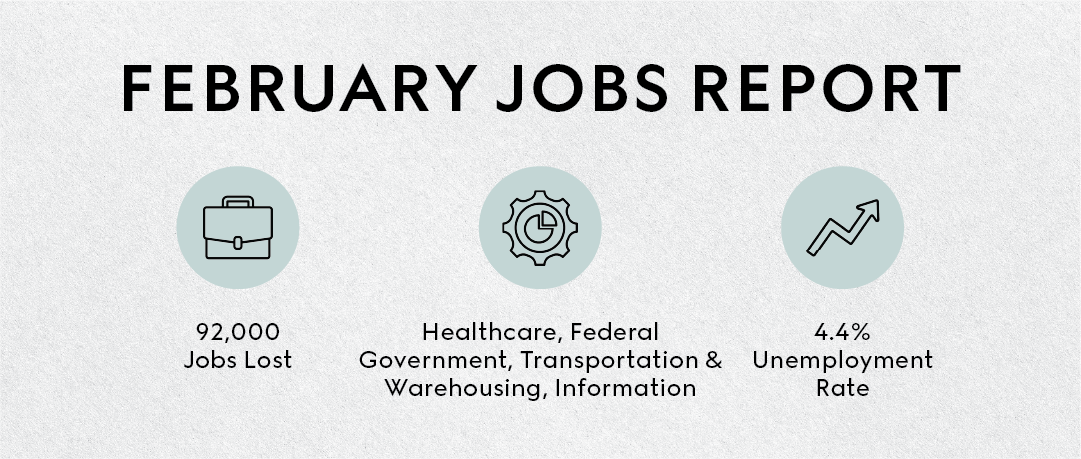
The U.S. economy lost 92,000 jobs in February, reversing January’s gains and marking the first notable monthly decline of 2026. Despite this drop, the unemployment rate remained relatively stable at 4.4%, suggesting the broader labor market is still holding steady.
A closer look at the data reveals that February’s slowdown was largely driven by sector-specific events, particularly strike activity in healthcare, rather than a widespread contraction across industries.
What Drove The February Job Decline
The biggest surprise in February came from healthcare, a sector that has consistently led job growth over the past several years.
Healthcare employment fell by 28,000 jobs, largely due to strike-related disruptions affecting physicians’ offices. Without this factor, overall job growth would likely have been closer to flat rather than negative.
At the same time, a few industries continued trends that have been building over the past year:
- Federal government employment continued its decline, down 10,000 jobs in February and now more than 330,000 jobs below its peak in late 2024.
- Transportation and warehousing also remained under pressure (-11,000 jobs), particularly in courier and delivery services, reflecting cooling logistics demand after the pandemic-era boom.
- Information sector jobs fell again (-11,000 jobs), extending a gradual contraction tied to ongoing restructuring in media and technology.
On the other hand, social assistance continued to grow (+9,000 jobs), reinforcing the steady demand for human services roles even during slower hiring periods.
Labor Market Stability Beneath The Headlines
While the headline payroll number turned negative, several indicators suggest the labor market remains relatively balanced.
The unemployment rate held steady, and workforce participation showed little change. Meanwhile, the number of workers employed part-time for economic reasons declined noticeably (-477,000), signaling some improvement in labor market conditions compared with previous months.
Wages also continued to rise. Average hourly earnings increased again in February, keeping annual wage growth close to the mid-3% range, strong enough to support income growth but not so rapid as to signal overheating.
Overall, the data points to a labor market that is cooling gradually rather than deteriorating sharply.
What This Means For Employers
For employers, February’s report reinforces that the labor market is settling into a more balanced phase after several years of volatility.
Hiring has slowed in many sectors, but demand remains strong in fields tied to essential services, infrastructure, and care-based industries. Meanwhile, layoffs and restructuring in government and certain white-collar industries are gradually increasing the availability of experienced talent.
For companies looking to hire, this environment presents an opportunity to:
- Access candidates who may not have been available during the tighter labor markets of 2021-2023
- Fill strategic roles with less competition from other employers
- Build teams intentionally as economic conditions stabilize
Organizations that move thoughtfully, but decisively, can take advantage of a more candidate-rich market in the months ahead.
Are you looking for top talent? Reach out to us today to get started.
What This Means For Job Seekers
For job seekers, February’s numbers may look discouraging at first glance, but the underlying picture is more nuanced.
Much of the job loss came from temporary factors, and several industries continue to hire steadily. Healthcare, social services, construction, and other service-based sectors remain key sources of opportunity.
Candidates may find that:
- Hiring processes are becoming more selective and deliberate
- Employers are prioritizing specialized skills and adaptable experience
- Opportunities may be stronger in industries with long-term structural demand
For those actively searching, the current market rewards candidates who are flexible, proactive, and focused on roles where their skills clearly solve business needs.
Looking for your next career change? Explore our open jobs today.
For further reading, refer to the U.S. Bureau of Labor Statistics or check out our other blogs on topics related to the job market.
Get the latest updates and exclusive content – subscribe to our newsletter!
Partner with Premier today.
Where in striving to do better, we transform lives in shared partnership with our exceptional employer and talent communities.


