

December 2025 Jobs Report: The Latest Employment Trends

The latest job report for December provides a comprehensive overview of the current state of employment in the United States.
December’s Key Findings
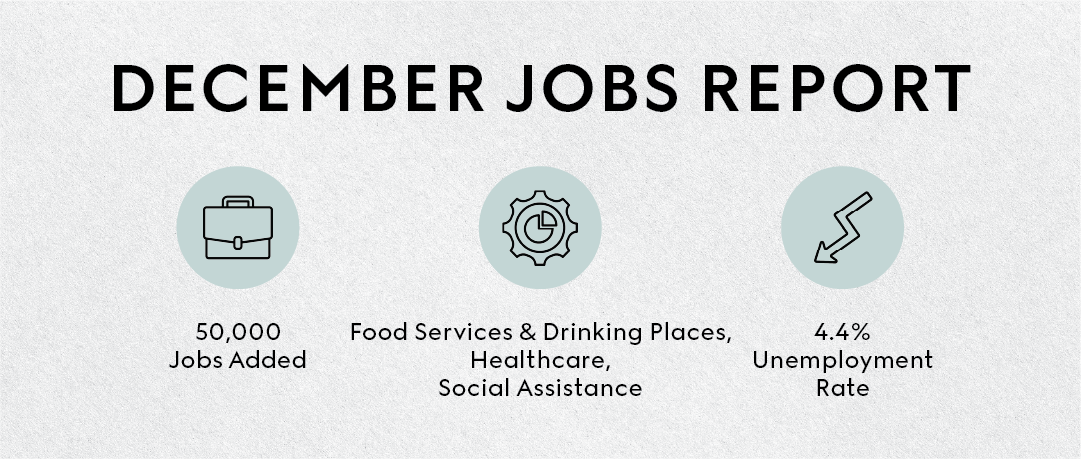
The U.S. Bureau of Labor Statistics reported that nonfarm payroll employment increased by 50,000 jobs in December, reflecting continued stagnation in job growth. The unemployment rate remained essentially unchanged at 4.4%. Overall, 2025 closed with 584,000 jobs added, an average of 49,000 jobs per month, far below 2024’s average of 168,000 monthly gains.
Key sectors include:
- Food Services & Drinking Places
- Healthcare
- Social Assistance
Notable declines:
- Retail Trade
Sector-Specific Employment Changes
Hiring remained concentrated in select service-related sectors, while retail experienced losses during the holiday season.
Food Services & Drinking Places
The sector added 27,000 jobs in December, continuing a slow but steady upward trend. In 2025, it averaged 12,000 new jobs per month, nearly identical to 2024’s monthly average of 11,000 jobs.
Healthcare
Healthcare added 21,000 jobs, including 16,000 jobs in hospitals. While still growing, the sector’s momentum has slowed compared to 2024, when it averaged 56,000 jobs per month versus just 34,000 jobs in 2025.
Social Assistance
Social assistance employment rose by 17,000 jobs, largely from gains in individual and family services. This sector continues to show resilience and steady expansion.
Retail Trade
Retail trade lost 25,000 jobs in December, which was unexpected during the peak holiday shopping season.
Losses were concentrated in:
- Warehouse clubs, supercenters, and other general merchandise retailers (-19,000 jobs)
- Food and beverage retailers (-9,000 jobs)
Electronics and appliance retailers gained 5,000 jobs, but this was not enough to offset broader declines. Overall, retail employment saw little net change in both 2024 and 2025.
Federal Government
Federal employment showed little change in December (+2,000 jobs). Since peaking in January 2025, the sector has declined by 277,000 jobs, a 9.2% reduction. This includes employees counted as employed while on paid leave or receiving severance.
Other major industries, including manufacturing, construction, wholesale trade, transportation, financial activities, and professional services, showed little or no movement in December.
Unemployment Rates
The national unemployment rate held steady at 4.4%, with 7.5 million individuals unemployed.
Unemployment rates by demographic group:
- Adult men: 3.9%
- Adult women: 3.9%
- Teenagers: 15.7%
- White population: 3.8%
- Black population: 7.5%
- Asian population: 3.6%
- Hispanic population: 4.9%
The number of individuals unemployed less than 5 weeks edged down to 2.3 million. Long-term unemployment (27 weeks or more) remained at 1.9 million, up 397,000 over the year, and now makes up 26.0% of all unemployed individuals.
- Labor Force Participation Rate: 62.4% (unchanged from November)
- Employment-Population Ratio: 59.7% (unchanged from November)
The number of people working part-time for economic reasons stayed at 5.3 million, up by 980,000 over the year.
The number of people not in the labor force but wanting a job was 6.2 million, up by 684,000 over the year. Of those:
- Marginally attached to the labor force: 1.8 million (unchanged)
- Discouraged workers: 461,000 (down by 183,000)
Wage Growth & Average Workweek
Wages continued to grow modestly in December:
- Average hourly earnings for all private nonfarm employees rose by 12 cents (0.3%) to $37.02
- Over the past year, wages have increased by 3.8%
- Private-sector production and nonsupervisory employees saw a smaller increase of 3 cents to $31.76
The average workweek edged down by 0.1 hour to 34.2 hours. In manufacturing, the average workweek declined by 0.2 hour to 39.9 hours, while overtime held steady at 2.9 hours. For production and nonsupervisory employees, the workweek was unchanged at 33.7 hours.
Updates To Prior Months’ Employment Data
Revisions to employment figures for October and November revealed a downward adjustment of 76,000 jobs.
- October 2025: Revised down by 68,000 jobs (from -105,000 to -173,000)
- November 2025: Revised down by 8,000 jobs (from +64,000 to +56,000)
What This Means For Employers
As 2025 comes to a close, the labor market continues to signal stability with select pockets of opportunity. While overall job growth remains modest, consistent hiring in healthcare, food services, and social assistance shows that demand for essential and people-driven roles isn’t slowing, even in a cooling market.
At the same time, slower hiring across retail and limited growth in other sectors suggest employers are being more intentional and selective with new hires. Wage growth remains steady, but not accelerating, and underemployment is rising, indicating that many workers are open to better-fitting, full-time opportunities.
For employers, this creates a favorable environment to:
- Access experienced talent that may be underutilized or open to change
- Fill critical roles with less competition than in prior years
- Reassess workforce strategies with a focus on efficiency, flexibility, and retention
Companies that move decisively, while staying compliant and competitive, will be best positioned to attract strong candidates as the market continues to normalize heading into 2026.
What This Means For Job Seekers
For candidates, the job market remains steady but strategic. While hiring isn’t surging across the board, opportunities continue to grow in healthcare, social services, and hospitality-related roles. Wage growth is holding firm, and employers are still investing in key positions, even if they’re hiring more cautiously.
Rising part-time employment and long-term unemployment figures suggest that many workers are reassessing their options, exploring new industries, or seeking roles that better align with their skills and long-term goals.
This is a smart time to:
- Be intentional about your job search and focus on roles with long-term stability
- Highlight transferable skills, flexibility, and adaptability
- Explore opportunities in resilient industries or with employers investing in growth
While the market may feel quieter, strong candidates are still in demand, especially those ready to move with clarity and confidence into the new year.
For further reading, check out our other blogs on topics related to the job market.
Are you looking for top talent? Reach out to us today to get started.
Looking for your next career change? Explore our open jobs today.
Get the latest updates and exclusive content – subscribe to our newsletter!
Partner with Premier today.
Where in striving to do better, we transform lives in shared partnership with our exceptional employer and talent communities.


