August 2026 Jobs Report: The Latest Employment Trends

August brought a stronger month for hiring, offering a more encouraging signal after several months of limited job growth.
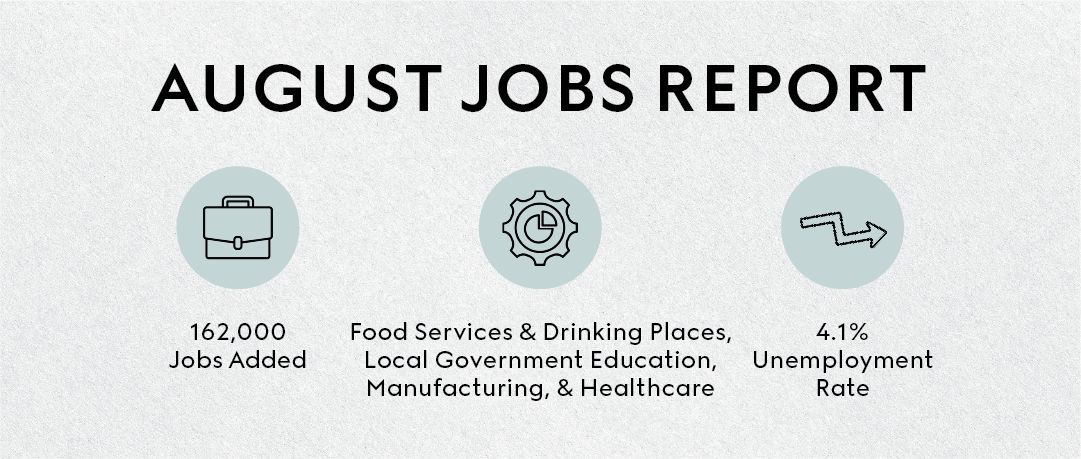
The U.S. economy added 162,000 jobs in August, well above the average monthly gain of 31,000 jobs over the prior year. The unemployment rate remained unchanged at 4.1%, while revisions to June and July added another 55,000 jobs to previously reported totals.
While the numbers point to renewed momentum, the gains were concentrated in a few areas. Food services and local government education accounted for much of August’s growth, while industries such as information continued to lose jobs.
A Stronger Month, Led By A Few Key Sectors
Food services and drinking places led August’s gains, adding 59,000 jobs, significantly above the sector’s average pace over the past year. This suggests continued strength in consumer-facing services following a relatively uneven summer for leisure and hospitality.
Local government education added another 42,000 jobs, though much of that increase offset the July decline. Looking beyond the month-to-month swing, employment in the sector has changed little since early 2025.
There were also signs of momentum elsewhere. Manufacturing continued to trend upward (+16,000 jobs), extending gains that began late last year, while healthcare also added jobs again (+13,000 jobs). However, healthcare growth remained below its average pace over the previous 12 months.
The clearest area of weakness remained information, which lost 23,000 jobs across data and computing infrastructure, publishing, broadcasting, and content-related businesses. The sector has now experienced consistent job losses over the past year.
Taken together, August represents a stronger month for hiring, but not yet a broad-based acceleration across the economy.
Signs Of Improvement Beneath The Headline
Several underlying indicators also moved in a positive direction.
The unemployment rate remained stable, while the number of people working part-time for economic reasons fell by 414,000. Labor force participation also edged higher, although it remains below where it began the year.
Revisions to previous reports strengthened the picture as well. July’s initially reported loss of 23,000 jobs was revised to a gain of 21,000, while June was revised slightly higher. Combined, June and July employment was 55,000 higher than previously estimated.
Wage growth continued, with average hourly earnings increasing 3.1% over the past year. However, that pace has moderated compared with earlier periods, another sign that the labor market is becoming more balanced.
Overall, August provides some evidence that hiring conditions are improving, but one stronger month does not necessarily signal a broader shift. The coming months will show whether this momentum extends beyond a handful of industries.
What This Means For Employers
For employers, August’s report suggests the hiring environment may be becoming more active, but competition for talent will continue to vary significantly by industry and skill set.
Growth in food services, manufacturing, and healthcare-related roles shows that employers in certain sectors are still expanding. At the same time, continued contraction in information may bring more experienced candidates into the market.
This environment gives employers an opportunity to:
- Move strategically on critical hires before competition increases
- Consider experienced candidates coming from industries undergoing restructuring
- Keep compensation and hiring expectations aligned with current talent availability
- Prioritize efficient hiring processes as strong candidates may have more options in growing sectors
Rather than assuming the market favors either employers or candidates, companies should look closely at the specific talent market for each role. The conditions affecting a healthcare search may look very different from those affecting a technology, marketing, or corporate position.
Are you looking for top talent? Reach out to us today to get started.
What This Means For Job Seekers
For candidates, August offers a more encouraging hiring picture, but opportunities remain uneven across industries.
The stronger headline number shows that employers are still creating jobs, particularly in service-based industries and areas like manufacturing and healthcare. At the same time, continued losses in information reinforce the importance of looking beyond job titles and considering where skills can transfer across industries.
Candidates can strengthen their search by:
- Targeting employers and sectors showing consistent hiring demand
- Highlighting transferable skills rather than limiting themselves to one industry
- Demonstrating measurable impact and specialized expertise
- Staying open to opportunities in industries that may be gaining momentum
August is a reminder that a slower labor market does not mean hiring has stopped. Opportunities are still being created, but knowing where demand is growing and positioning your experience accordingly matters more than ever.
Looking for your next career change? Explore our open jobs today.
For further reading, refer to the U.S. Bureau of Labor Statistics or check out our other blogs on topics related to the job market.
Get the latest updates and exclusive content – subscribe to our newsletter!
Partner with Premier today.
Where in striving to do better, we transform lives in shared partnership with our exceptional employer and talent communities.